
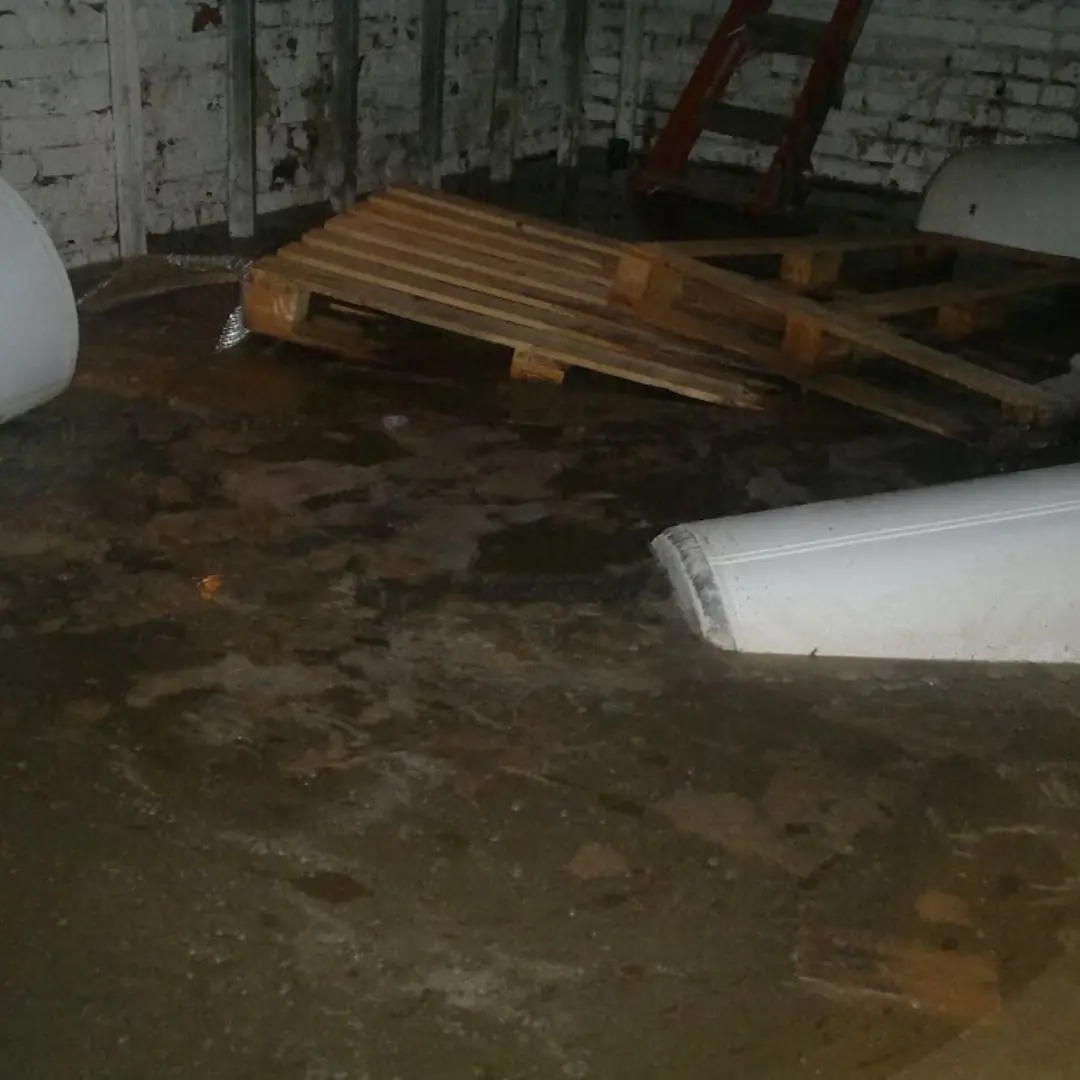
You spent the last three years renovating that basement. New drywall, insulation, flooring, electrical work, a second bedroom, a rec room. Then one heavy rain, one sump pump failure, one burst pipe, and water is running across your new finished floor.
This is when you discover that finished basement water damage is in a completely different category of expensive than what the guy next door with the bare concrete floor is dealing with.
Why finished basements flood so much worse
A bare concrete basement with water damage is annoying. You pull the pump, dry the floor, and move on. A finished basement with water damage is a structural demolition problem.
Here's what actually happens:
- The drywall soaks it all up. Drywall is porous. When water touches it, the board absorbs moisture like a sponge. It doesn't evaporate back out at the speed it came in.
- The insulation traps it. If you have fiberglass or foam board behind the drywall, that material absorbs water and holds it. It doesn't dry from the inside out.
- The framing gets wet. Wood studs and plates behind the drywall get soaked. Wood that stays wet starts rotting in as little as three to four weeks.
- Mould grows in the cavities. Mould can start growing inside the walls in 24 to 48 hours. You can't see it, but it's there.
- Your flooring is glued down. Whatever you put on that basement floor (carpet, vinyl, laminate, engineered wood) is probably glued. Water underneath it becomes trapped. It can't dry.
In a bare basement, water just sits on concrete until you remove it. In a finished basement, water infiltrates an entire assembly of materials that are designed to keep it out, not deal with it being there.
What it actually costs to fix
For a typical finished basement in a Toronto-area home that takes on even a few inches of water, here's what restoration and repair look like:
- Water extraction and drying: $2,000 to $4,000 for industrial equipment (pumps, dehumidifiers, air movers). This is the emergency part that stops the bleeding.
- Drywall removal and replacement: $3,000 to $8,000 depending on how much wall area was affected and whether you had to cut it open to let it dry first. If water went 2 feet up, you're removing and replacing 2 feet of drywall on every wall that was wet.
- Insulation replacement: $800 to $2,500 for new fiberglass or foam board, depending on the square footage. You can't reuse insulation that's been underwater.
- Framing lumber replacement: $1,500 to $4,000 if any studs or sill plates are rotted. You have to replace those, and it involves structural work.
- Flooring removal and replacement: $3,000 to $10,000 depending on what you had down there. If it was nice laminate or vinyl plank, it all comes out. If it was carpet, that's especially bad because carpet holds water and promotes mould.
- Mould remediation: If mould is growing (and after 48 hours it usually is), $2,000 to $6,000 for proper containment, removal, and treatment of affected areas.
- Electrical inspection and rewiring: After water damage, anything electrical has to be inspected. Circuits might need replacing. Budget $500 to $2,000.
That adds up to $13,000 to $37,000 in restoration and repair for a typical finished basement flood in the GTA. A bare basement might run $3,000 to $6,000.
And that's if you move fast. If you wait a week thinking it will dry on its own, add another 30 to 50 percent because the damage has gotten worse.
Why it happens so fast in Toronto
The GTA sees the perfect storm for basement flooding. We get heavy summer thunderstorms that dump 40 to 60mm of rain in an hour. City sewers can't handle that volume. Older Toronto neighborhoods like the Annex, Little Italy, Parkdale, and Leslieville have combined sewer systems where stormwater and sewage share pipes. When it rains hard, sewage backs up into basements.
Finished basements compound the problem because the additional materials (drywall, insulation, flooring) change how water moves. It doesn't drain as quickly as it would off bare concrete. It sits and soaks.
In Mississauga, Vaughan, and the newer suburban areas, the problem is sump pump failure or foundation cracks letting in water. Finished basements in those homes are equally at risk, and the damage spreads just as fast.
How to actually prevent it
If you're planning a basement renovation or already have a finished space, you have options:
- Install a sump pump with a battery backup. This is your first line of defense. If power goes out during a storm, a battery backup keeps pumping for hours. Cost: $1,500 to $3,500 installed.
- Consider a backwater valve. If sewer backup is the risk (and in older Toronto homes it absolutely is), a backwater valve stops sewage from flowing back into your basement. The City of Toronto offers a rebate up to $3,400. Net cost after rebate: often minimal.
- Grade and drainage around the house. Make sure the ground slopes away from your foundation. Make sure downspouts discharge at least 6 feet away, not directly against the foundation. This is free to check and fixes most water intrusion problems before they start.
- Seal basement cracks before finishing. Have any visible cracks in the concrete inspected. Small cracks can be sealed with hydraulic cement or epoxy. Cost: $300 to $1,000 depending on how many cracks. This prevents a ton of headache later.
- Use water-resistant materials when you finish. Use drywall joint compound rated for damp basements. Use styrofoam or closed-cell foam insulation instead of fiberglass (it doesn't hold water the way fiberglass does). Consider vinyl plank flooring instead of carpet (water doesn't destroy vinyl like it does carpet, and you can dry under it). These materials cost a bit more, but they mitigate damage dramatically if water gets in.
- Keep the basement dehumidified year-round. A basement dehumidifier that runs continuously keeps humidity low and discourages mould. This is different from running a dehumidifier after a flood (that won't work), but preventatively, it helps.
If you already have water damage
If your finished basement is wet right now, the clock is running. You have maybe 6 to 12 hours before mould starts growing inside the walls. You have 24 to 48 hours before the damage becomes substantially more expensive to fix.
Stop trying to DIY this with fans and household dehumidifiers. Call for industrial drying right now. The difference between moving fast and waiting is thousands of dollars. It's also the difference between fixing this and dealing with mould remediation and structural repairs for years.
A professional water damage restoration crew has the equipment to dry an entire wall assembly, not just the surface. They'll place drying equipment that actually removes moisture from inside the cavity. They'll check for hidden damage with thermal imaging. They'll document everything for your insurance claim.
If your finished basement is taking on water, call us at 647-563-9966. We'll extract the water and get the drying process started today. We bill your insurance directly, and we've handled thousands of basement floods across Toronto, Mississauga, Vaughan, Markham, North York, Etobicoke, Scarborough, Richmond Hill, and Oakville.
The Preferred Group
IICRC Certified restoration team. Toronto-based, working across the GTA since 2006. Thousands of finished and unfinished basement floods handled.